
Did you know that the rail system forms the backbone of every solar installation? While brackets connect panels to the roof, solar mounting rails hold the entire structure together. They determine alignment, carry the load, and ensure every panel remains secure for decades.
In South Africa, where wind conditions, roof substructure and roof sheets profiles, and project types vary widely, choosing the right rail is just as important as choosing the right bracket. A high-quality solar mounting rails not only ensures structural integrity but also defines how easily and safely a system can be installed.
At Valsa Engineering, we design and manufacture a full range of aluminium solar mounting rails, tested in accordance with SANS 10160 standards for load and wind performance. Each profile is locally produced, locally stocked, locally tested, and locally supported, engineered for the real conditions faced by South African installers.
This article explores why rail design matters, how different profiles serve specific roof types, and how a fully aluminium mounting solution prevents corrosion and structural failure. It also links to our previous technical insights on brackets and splice kits, completing the picture of a strong, compliant mounting system from start to finish.
Watch our video “Mastering Solar Mounting Rails for Roof Structure Installations” to see how to build strong, compliant, and efficient rail systems from start to finish.
The Role of Solar Mounting Rails in Structural Integrity
Solar mounting rails are far more than simple beams that hold panels in place. They distribute weight evenly across the roof, absorb wind and temperature forces, and keep panels perfectly aligned over time. When the rail performs well, the whole structure performs well. It is important to note that if the rails deflect beyond allowable limits defined by standards, it can compromise panel alignment and void the manufacturer’s warranty.
Every system must withstand three key forces: compression, uplift, and shear. If a rail bends, slips, or loosens under any of these loads, the result can be panel movement, damaged clamping zones, or leaks on the roof.
For this reason, all Valsa solar mounting rails are designed according to SANS 10160 wind and load conditions. Each profile is tested to perform reliably in high-wind coastal areas, elevated terrain zones, and inland environments.
Our rails use continuous slot design that allows fasteners to slide and adjust freely, enabling any rail length needed within a structure. This flexibility ensures the load is shared evenly across joints and clamps.
When combined with Valsa’s precision brackets and clamps, the rail becomes part of an integrated system that resists vibration, reduces stress on sheeting, and maintains the correct panel geometry through the entire lifespan of the installation.
If you missed it, we covered how bracket choice influences structural performance in our previous article, Solar Panel Mounting Brackets: Choosing the Right Fit for Your Roof in South Africa. Together, brackets and rails create the structural backbone that installers can rely on.
Designed for South African Roof Profiles

Not all roofs are created equal and neither are rails. Valsa’s solar mounting rails are designed to pair precisely with the wide variety of sheeting profiles used across South Africa. Because each bracket connects differently, the orientation and slot configuration of the rail must complement that connection perfectly.
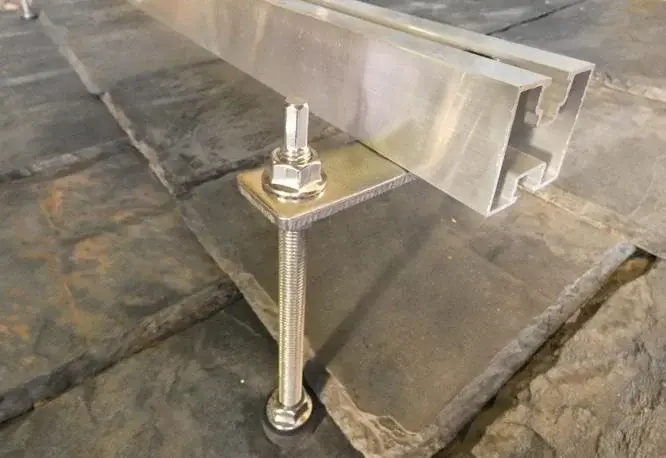
Top and Bottom Slotted Rails (40 × 40 mm)
Used for concealed-fix profiles such as Saflok, Brownbuilt, Kliplok, slate roof (Hanger Bolts), Diamondek, and others, as well as elevated structures. This configuration provides high tensile resistance, enabling direct clamp mounting and strong pull-out performance. It’s ideal where load transfer and alignment accuracy are critical.
Top and Side Slotted Rails (40 × 40 mm)
Suited to corrugated, IBR, tiled roof, Novotexi, Craft-Lock, Harvey Tile and other applications. This design allows side access for easier installation and quick clamping, especially on complex roof geometries.

Three-Slot and Heavy-Duty Rails (56 × 28 mm)
Developed for high-load or large-span projects such as ground mounts, carports or commercial systems. These rails maintain rigidity over longer spans and reduce deflection under weight or wind uplift.
Aesthetic Options

Valsa also offers solar mounting rails in black powder-coated finishes for projects where visual design matters, such as building-integrated arrays. This coating enhances appearance only; it is not a corrosion barrier, because our solar mounting rails already resist corrosion naturally thanks to their hardened aluminium alloy composition.
Each of these profiles connects seamlessly with the correct Valsa brackets, ensuring a perfect mechanical interface and reliable performance across all major South African roof types.
Material Advantage: Hardened Aluminium T6 Alloy
Every Valsa solar mounting rail is made from hardened aluminium alloy (T6 grade), combining lightweight design with exceptional tensile strength. Unlike mild steel or composite alternatives, aluminium does not rust, flake, or lose structural integrity when exposed to moisture and temperature changes.
The T6 tempering process further strengthens the alloy, giving each rail high stiffness while remaining easy to handle and cut on site. This material choice provides the best balance between durability, cost efficiency, and installer practicality.
Because aluminium forms a natural oxide layer, it resists corrosion without any additional coatings. The result is a maintenance-free solar mounting rails system that performs for decades, even in coastal or industrial environments.
Did you know that most imported rails use T5 aluminium, which has significantly lower strength? The T6 tempering used in Valsa rails delivers between 25% and 40% higher mechanical and tensile performance, ensuring superior rigidity and reliability under load.
Avoiding Galvanic Corrosion – Why Full Aluminium Systems Matter
In some installations, cost-driven substitutions create hidden risks. Installers occasionally replace aluminium rails with P2000, Unistrut or similar steel channels or other dissimilar metals to save on initial material costs.
However, mixing metals introduces a serious chemical risk known as galvanic corrosion – sometimes referred to as bi-metal corrosion.
Did you know, when roof sheets corrode, it becomes the installer’s responsibility and liability. Any structural integrity failure resulting from the use of non-compliant or poor-quality materials will rest with the installer, not the product manufacturer.
When two different metals come into electrical contact, where current can flow, in the presence of moisture, one metal (the less noble one) begins to corrode rapidly. In solar systems, this often occurs when aluminium brackets, clamps, and panel frames are mounted onto steel rails. The result can be accelerated corrosion at the connection points, staining on panels, and eventual structural weakening that spreads from the rail to the modules themselves.
Valsa’s complete aluminium mounting solution eliminates this risk entirely. All components – brackets, solar mounting rails, clamps, and accessories – share the same material type and protective oxide layer.
That uniformity ensures electrical and chemical compatibility, keeping the entire structure stable and corrosion-free for the lifetime of the installation.
Engineered for Load and Wind Performance
Each Valsa rail design is validated against the SANS 10160 Wind Conditions and Loadings regulations. These standards define how structures must behave under different regional wind speeds, terrain categories, and roof exposures.
Our engineering process evaluates:
- Wind uplift pressures for inland and coastal zones.
- Wind downforce for inland and coastal zones.
- Terrain categories (A, B, C) representing urban, suburban, and open rural conditions.
- Span calculations to ensure the correct spacing between purlins or supports.
Because the rails can join continuously and accept fasteners at any point along their slots, installers can create the exact span required without compromising strength. Each connection maintains full mechanical load transfer, allowing long, seamless runs with consistent stiffness.
We also recommend correct torque settings and the use of spring washers to prevent loosening during thermal changes and vibration cycles, ensuring every joint stays secure under long-term stress.
For detailed load data, wind charts, and spacing recommendations, download the Valsa Solar Mounting Rails Datasheet from our technical resource section.
Adaptability and Efficiency with the L-Shaped Bracket

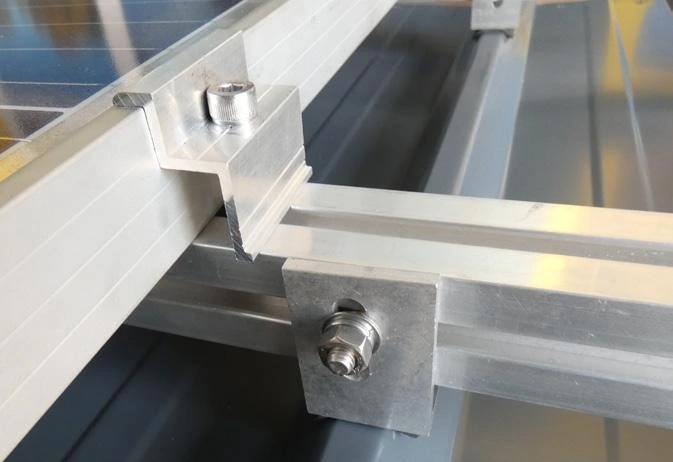
The Valsa L-Bracket was developed to give installers more flexibility without changing the core rail system. When projects require a different orientation, for example, when a roof profile designed for top-bottom connection needs to use a top-side rail, the L-Bracket makes the switch possible instantly.
This adaptability saves both time and cost on site. Installers can use the same stocked solar mounting rails profiles across multiple roof types, knowing that the L-Bracket maintains structural integrity and alignment. It also ensures that load transfer remains consistent with SANS 10160 standards, even when configuration changes are made.
By reducing the number of unique rail types needed on site, Valsa simplifies logistics and keeps installation efficient without compromising safety or strength.
How Proper Rail Connection Prevents Failures
A mounting system is only as strong as its weakest joint. That is why Valsa developed precise splice kits that maintain continuity between connected rails. When splices are poorly aligned, under-tightened, or mixed between brands, they can create small gaps that cause vibration and stress concentration, problems that worsen over time.


Common connection issues include:
- Incomplete insertion of the splice bar, reducing load transfer.
- Over-torqued bolts, which deform the aluminium profile.
- Neglecting thermal expansion gaps, leading to distortion during temperature cycles.
Valsa’s Solar Rail Splice Kits are engineered to eliminate these issues entirely. They feature tight manufacturing tolerances, interlocking design for automatic alignment, and include both flat and spring washers to keep joints secure even under vibration. We recommend tightening to 15 N·m torque for optimal clamping force without deformation.
Each kit is load tested to ensure compliance with SANS 10160 wind uplift conditions. Together with the rail and bracket, they create a continuous, rigid structure that maintains perfect alignment and prevents fatigue failure over time.
Learn more about proper rail connection techniques in our cluster article Why Strong Solar Rail Splice Kits Keep Every Installation Aligned and Secure.
Installation Precision and Maintenance Considerations
Even the strongest rails can fail if installed incorrectly.
During installation, ensure:
- The rails remain level and straight across the array.
- Joints are fully inserted and properly torqued.
- Clamping zones match manufacturer recommendations for each panel type.
Regular inspections after severe wind events help confirm that all fasteners remain tight and that no visual bending or vibration marks appear on the rail.
Because Valsa’s rails use the same material as the brackets and clamps, there is no risk of multi-metal fatigue or bi-metal corrosion at contact points, even after many years of service. Our technical team provides remote assistance for installers who need help confirming alignment, spacing, or clamping configurations.
Why Choose Valsa’s Solar Mounting Rails
Valsa’s rails are not generic imports adapted for local roofs. They are designed from the ground up for South African conditions and the specific load requirements defined by SANS 10160.
Our solar mounting brackets and rail solutions are officially endorsed by leading South African roof sheeting manufacturers – including Safintra, Youngman Roofing, Clotan Steel, and others.
These endorsements confirm that Valsa’s products are engineered for perfect compatibility, performance, and compliance across a wide range of local roof profiles.
We invite our partners and customers to request copies of these endorsement letters directly from us.
Having verification from the actual roof manufacturers themselves is an assurance of reliability that most imported or generic solar mounting brands simply cannot offer.
Choosing Valsa means choosing:
- Full aluminium construction (T6 hardened alloy) for superior strength and corrosion resistance.
- Exact compatibility with all major South African roof profiles.
- Locally manufactured precision ensuring consistent quality and faster delivery.
- Comprehensive system design with matching brackets, splice kits, and clamps.
- Proven test data verifying performance well above minimum load requirements.
- Technical support from an experienced engineering team who understand local site challenges.
- Designed to accommodate and cater for local roof substructures and sheeting, unlike imported systems that are built for foreign roof types and environmental conditions.
With stock available nationwide and expert guidance only a call away, Valsa delivers not just a product but a full structural solution that installers can trust, specifically designed to suit South African roofs and site conditions.
Frequently Asked Questions
What makes Valsa’s Solar Mounting Rails different from imported ones?
Valsa’s rails are designed specifically for South African buildings roof profiles and conditions. Imported rails are often made for only a few international systems and can mismatch local tolerances and conditions. Valsa’s rails ensure exact fit, local stock, and verified performance.
Are your rails suitable for coastal regions and high-wind areas?
Yes, all Valsa rails are tested under SANS 10160 load and wind conditions. The hardened aluminium alloy resists salt corrosion naturally, making it ideal for coastal environments. It is also important to consider Valsa’s proven ability to maintain allowable deflection limits, as excessive deflection can compromise panel alignment and void the manufacturer’s warranty.
How do I choose between top-side and top-bottom rails?
This depends on the roof sheeting type and the bracket used. For example, concealed-fix sheets such as Saflok and Diamondek use top-bottom slots, while corrugated or IBR roofs use top-side slots. Our technical team can assist in identifying the correct combination. Valsa’s online Mounting Structure Roof-Top Calculator automatically prescribes the correct compliant kit for your project. Simply enter your site details, and with one click, the system generates a configuration that meets SANS standards and roof compatibility requirements. Register with us to gain access to this exclusive engineering tool and streamline your design process.
Do your rails require specific splice kits?
Yes. Valsa splice kits are designed for our own rail tolerances to maintain perfect alignment and load transfer. Using non-compatible kits can lead to vibration and reduced strength.
Can the rails be powder-coated for design projects?
Absolutely. Black powder-coated rails are available for aesthetic reasons where visible installations are preferred. The coating is decorative only, since aluminium already provides full corrosion protection. All colours are available on request.
Valsa’s Solar Mounting Rails
Strong solar systems start with strong foundations, and nothing defines that strength like the rail.
Valsa’s Solar Mounting Rails combine local engineering expertise, tested performance, and complete system compatibility to deliver reliability for every project.
From residential rooftops to large-scale ground mounts, and carport solutions, our aluminium rails provide the structural precision that keeps installations secure, efficient, and compliant year after year.
For technical specifications, datasheets, or assistance with design selection and rooftop calculator, contact Valsa Engineering today, and experience the strength of South African engineering, built into every rail.


